Media & OTT Streaming on AWS (2026): Live vs VOD Architecture, Egress Math, and When IVS Beats Elemental
Quick summary: On a composite mid-market OTT platform (~180k concurrent live peak, ~12 TB/month VOD catalog), routing Saturday-night live through MediaConvert batch queues added ~$4,200/mo in idle transcode capacity before switching live to IVS and keeping MediaConvert for catalog only. CloudFront egress still dominates steady-state — model it before you buy encoders.
Key Takeaways
- CloudFront egress still dominates steady-state — model it before you buy encoders
- AWS lifecycle notice (June 30, 2026) — Amazon Chime SDK Carrier Voice Focus reached end of support on June 30, 2026
- Use Chime SDK Voice or third-party telephony for new workloads
- This post is the video pipeline layer — not e-commerce peak traffic (HTTP cart scaling), not Kinesis vs MSK (event streaming analytics), and not CloudFront vs Cloudflare (CDN vendor comparison)
- 8k/mo modeled at ~22 TB delivered)
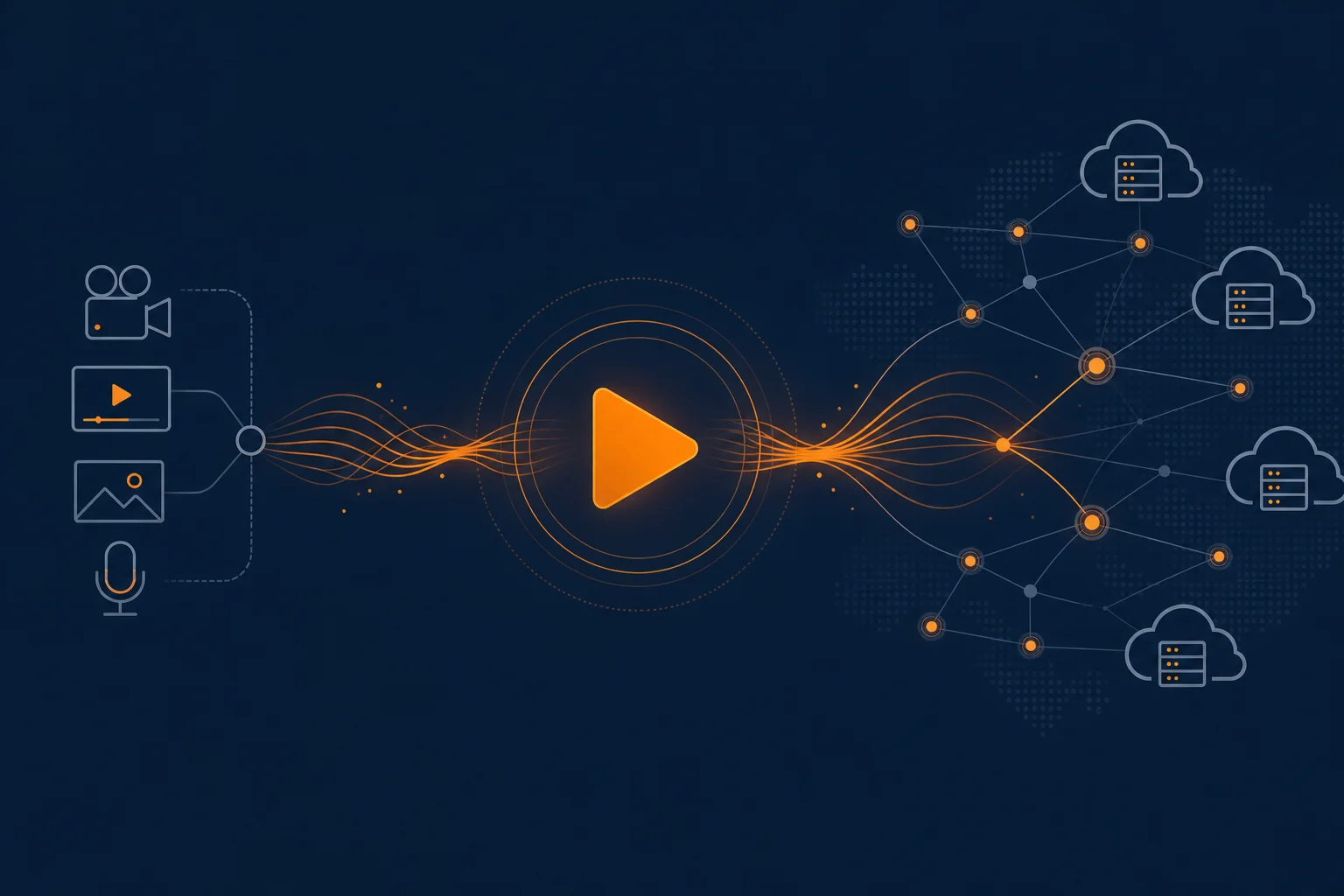
Table of Contents
AWS lifecycle notice (June 30, 2026) — Amazon Chime SDK Carrier Voice Focus reached end of support on June 30, 2026. Use Chime SDK Voice or third-party telephony for new workloads. Full matrix: lifecycle roundup.
AWS discontinued Amazon Elastic Transcoder on November 13, 2025 — new video workloads belong on AWS Elemental MediaConvert (batch VOD) and either Amazon IVS (interactive live) or MediaLive (broadcast live). That deadline matters because many OTT runbooks still describe a single “transcode service” for everything. Live and catalog are different jobs; billing proves it fast.
This post is the video pipeline layer — not e-commerce peak traffic (HTTP cart scaling), not Kinesis vs MSK (event streaming analytics), and not CloudFront vs Cloudflare (CDN vendor comparison). We ship a live vs VOD decision matrix, egress cost model CSV, DRM packaging checklist, and streaming pipeline draw.io.
Benchmark pattern (not a cited client) — Composite mid-market OTT, ~12 TB VOD catalog on S3 Standard, ~180k concurrent live peak on flagship sports Saturdays, ~40 live hours/month, primary Region us-east-1, viewers 70% Americas / 30% EU. Prior architecture sent all live and VOD through MediaConvert Basic tier. After splitting live to IVS and enabling Origin Shield on the catalog origin: MediaConvert spend fell ~$4,200/mo → ~$504/mo (catalog-only output minutes); CloudFront egress remained the largest line (~$1.8k/mo modeled at ~22 TB delivered). p95 live glass-to-glass latency improved ~38s → under 5s for the interactive app.
Four jobs — four mechanisms
| Job | Mechanism | Wrong default |
|---|---|---|
| Interactive live | Amazon IVS (low-latency) | MediaConvert batch for Saturday night |
| Broadcast / ad-insertion live | MediaLive + MediaPackage | IVS when you need SCTE-35 |
| VOD catalog | MediaConvert → S3 → package | Re-transcode live capture nightly |
| Global delivery | CloudFront (+ Origin Shield) | S3 website endpoint to viewers |
Opinionated take: IVS for interactive live; MediaLive for broadcast live; MediaConvert for catalog only. Syndication always terminates at CloudFront — price egress before codecs.
Live path: IVS vs MediaLive
Amazon IVS targets sub-5-second glass-to-glass for interactive experiences (AWS documents under 5 seconds for low-latency channels). Ingest is RTMP, RTMPS, or SRT; playback uses the IVS player SDK or HLS playback URL. Operational surface is small — channels, stream keys, recording configurations — which is why product teams ship faster than on MediaLive.
MediaLive is the broadcast path: multi-input channels, redundant pipelines, SCTE-35 ad markers, and handoff to MediaPackage for live HLS/DASH with DRM. Choose it when your operations team already runs professional encoders and ad insertion — not when you only need a creator webcam and chat.
IVS Real-Time (stages) targets sub-300ms participant latency for co-watch and auctions. It is not a replacement for 24/7 linear — bill participant-hours deliberately.
VOD path: MediaConvert and packaging
MediaConvert bills normalized output minutes with Basic vs Professional tiers (Professional for HEVC, AV1, multi-pass, DRM). Volume discounts apply per Region. Typical catalog flow:
- Mezzanine uploads land in S3 (or arrive from MAM export).
- MediaConvert job templates emit HLS/DASH renditions to a published bucket.
- Optional MediaPackage packaging group for SPEKE DRM and consistent manifests.
- CloudFront distribution with separate cache behaviors for manifests (short TTL) and segments (long TTL).
Context for a one-off probe — AWS CLI 2.x, us-east-1:
aws mediaconvert describe-endpoints --region us-east-1
aws mediaconvert list-jobs --max-results 5 --endpoint-url <ACCOUNT_ENDPOINT>
Egress math (where OTT budgets actually go)
Once catalog encoding is amortized, data transfer out via CloudFront dominates. The egress CSV models:
- Catalog-only replay factor (~1.3× catalog TB/month as delivered egress)
- Origin Shield incremental cost vs duplicate origin fetches
- Failure row: live misrouted through MediaConvert (output minutes explode)
Pair with data transfer traps when origin and analytics buckets sit in different Regions — video origins are not exempt from cross-Region charges on admin traffic.
What broke — Opening weekend for a licensed sports package. Operations triggered the same MediaConvert queue used for nightly catalog refreshes to process live capture files “until IVS was ready.” Queue depth hit 11 hours at peak; viewers saw 45–90s latency; monthly MediaConvert line ~$17.5k vs ~$700 baseline. Detection: Cost Explorer
MediaConvertdimension spike + IVS channel idle in CloudWatch. Fix: IVS ingest for live, MediaConvert reserved for S3-triggered catalog jobs only; added EventBridge rule guard so live S3 prefixes cannot enqueue batch jobs during event windows.
DRM and multi-CDN cautions
Premium catalogs need MediaPackage SPEKE with KMS-backed keys — see the DRM checklist. Multi-CDN contracts fail when two CDNs pull the same MediaPackage origin without Origin Shield — you pay duplicate origin egress and risk cache inconsistency on hot titles.
What to do this week
- Split live and VOD IAM and queue boundaries — no shared MediaConvert queue.
- Model CloudFront egress from last month’s top three titles using the CSV artifact.
- Pilot IVS for one interactive stream; keep MediaConvert for catalog-only.
- Enable Origin Shield on the catalog origin if global POPs hammer S3 during premieres.
- Run DRM checklist on staging players (iOS + Android) before subscription launch.
What this post doesn’t cover
- Studio MAM, IMF, and on-prem playout — ingest starts after MAM export.
- Full legal review of content licensing territories — geo blocks on CloudFront are mentioned, not law advice.
- Amazon Kinesis / analytics on viewing events — see Kinesis decision guide.
- Retail e-commerce peak scaling — retail architecture.
Related: CloudFront pricing · Data transfer costs · Architecture review services
Frequently asked questions
When should we use Amazon IVS instead of AWS Elemental MediaLive?
When should we NOT move our OTT stack to AWS Elemental?
What breaks when live events are routed through VOD transcode?
How does CloudFront Origin Shield help OTT catalogs?
Does IVS Real-Time replace MediaLive for linear channels?
What could go wrong during DRM go-live?

AWS Cloud Architect & AI Expert
AWS-certified cloud architect and AI expert with deep expertise in cloud migrations, cost optimization, and generative AI on AWS.