What Makes a Top AWS Cloud Consulting Partner (And How to Choose One)
Quick summary: AWS Cloud Consulting Partners vary wildly in quality and capability. This guide explains AWS Partner tiers, what differentiates top partners from generalists, and concrete evaluation criteria for choosing a consulting partner aligned with your business.
Key Takeaways
- AWS Cloud Consulting Partners vary wildly in quality and capability
- This guide explains AWS Partner tiers, what differentiates top partners from generalists, and concrete evaluation criteria for choosing a consulting partner aligned with your business
- AWS lifecycle notice (June 30, 2026) — Amazon Bedrock Agents Classic is now Bedrock Agents Classic, in maintenance for new customers after July 30, 2026
- Net-new agent builds should use Bedrock AgentCore
- The AWS partner marketplace includes thousands of firms — from freelancers to Accenture — all claiming AWS expertise
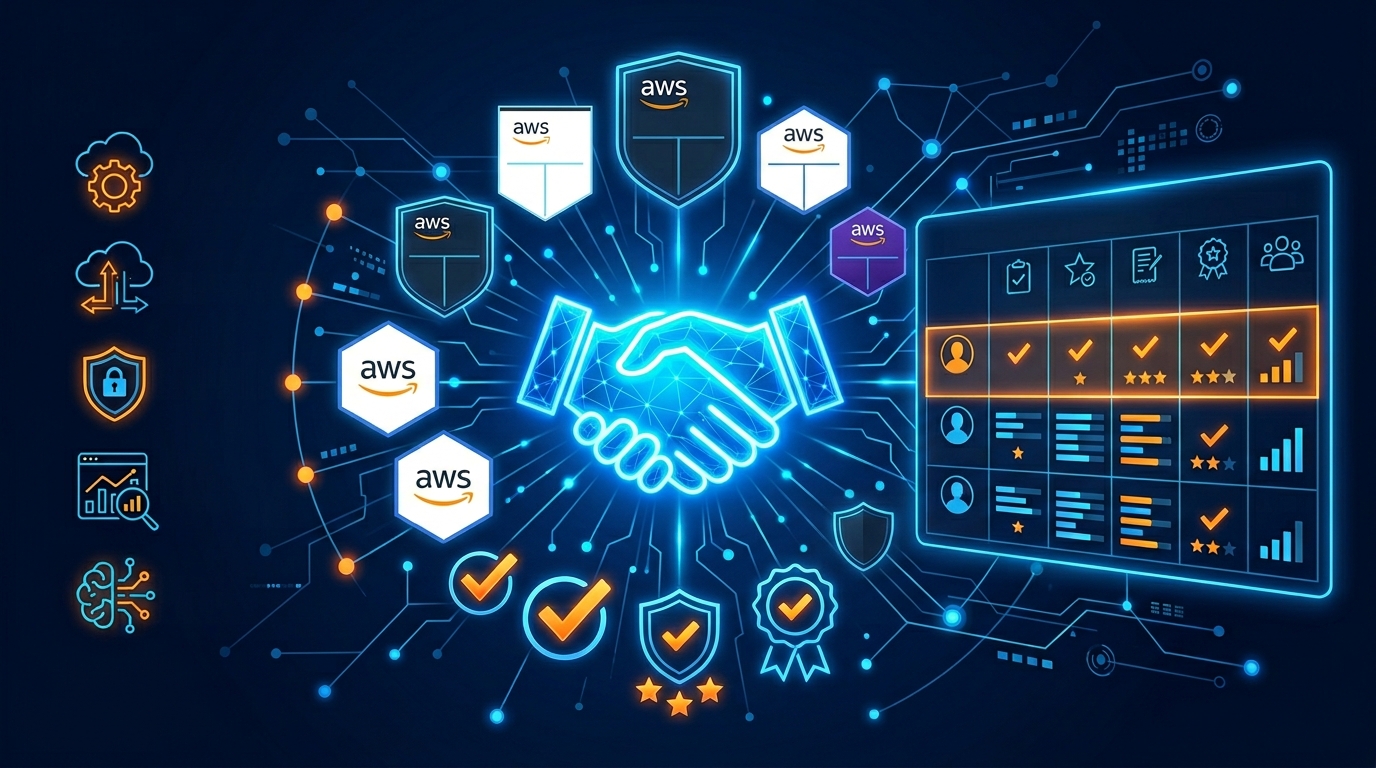
Table of Contents
AWS lifecycle notice (June 30, 2026) — Amazon Bedrock Agents Classic is now Bedrock Agents Classic, in maintenance for new customers after July 30, 2026. Net-new agent builds should use Bedrock AgentCore. Full matrix: lifecycle roundup.
The AWS partner marketplace includes thousands of firms — from freelancers to Accenture — all claiming AWS expertise. The gap between a consulting partner who understands AWS and one who can execute complex infrastructure reliably and cost-efficiently is vast, and the difference often does not become obvious until you are several months into the engagement.
The AWS Partner Network publishes partner tiers and competencies. But tiers are self-reported or lightly validated; competencies are marketing designations. The real question is: How do you evaluate whether a partner can actually deliver the outcomes your business needs?
Understanding AWS Partner Tiers
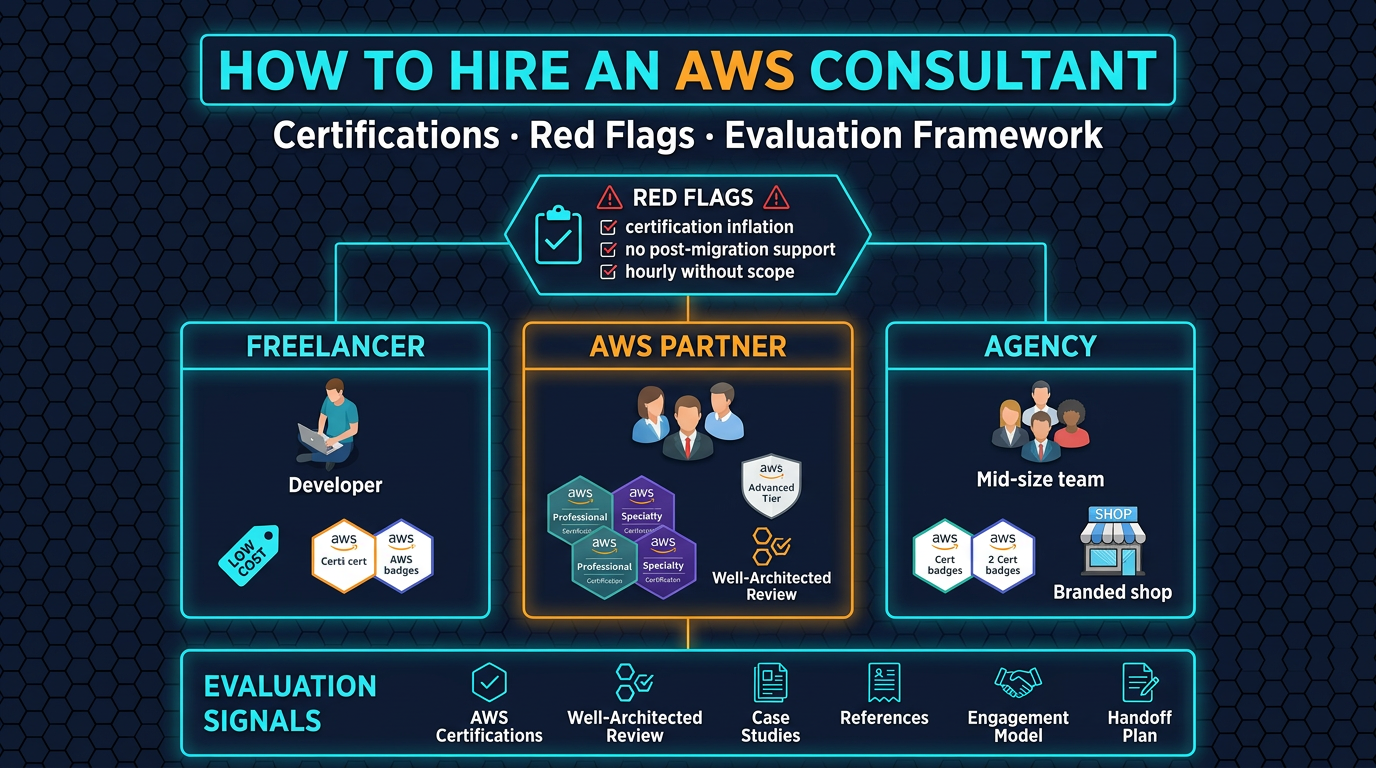
Registered. Enrolment in the AWS Partner Network with no validation of delivery. This tier includes consultants building credibility and small firms with a limited AWS practice. Useful for low-stakes projects or budget-constrained work; risky for mission-critical infrastructure.
Select. The first validated Services Partner tier. It requires trained and certified people plus launched customer opportunities recorded with AWS, and Select partners are listed in the AWS Partner Solutions Finder. This tier includes many regional consulting firms and specialists.
Advanced and Premier. The higher tiers add public customer references and customer satisfaction responses on top of the Select requirements, with larger certified teams and more launched work. Premier is the top tier and is held by the largest AWS practices.
A higher tier tells you the practice is bigger and has more AWS-recorded work. It does not tell you who will be on your project, so evaluate the delivery team either way.
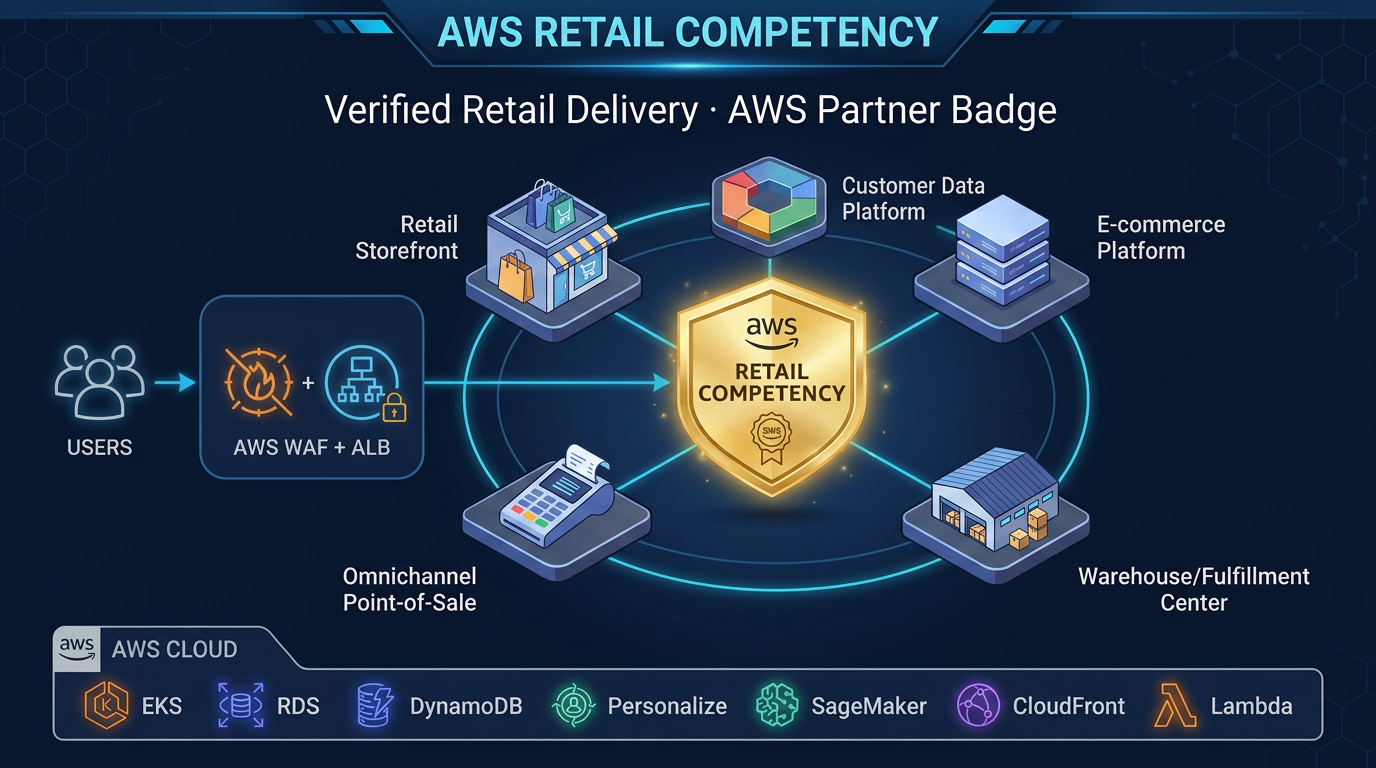
Competency Designations. Specializations like Retail Competency, Foundations, Migration Competency, Security. These designate domain focus but do not indicate tier. A partner at any validated tier can hold a competency; a partner holding Retail Competency has had retail-specific work validated by AWS. When evaluating partners, look at tier and competency together.
What Differentiates Top AWS Consulting Partners
Architecture-driven cost optimization. The best AWS consulting partners do not just migrate to the cloud — they optimize for cost during the migration. They recommend Reserved Instances, Savings Plans, and architectural trade-offs (Aurora vs RDS, Fargate vs ECS) that reduce monthly spend. Cost is a design constraint, not an afterthought. Weak partners treat cost as an operational concern addressed post-deployment. When a partner discusses your AWS bill, you should hear specific mechanisms: “We will reduce data transfer costs by consolidating NAT Gateways and increasing CloudFront cache hit ratio,” not “We will optimize your cloud costs.”
Deep domain expertise. Top partners specialize in specific industries or workload types: fintech, retail, healthcare, data-intensive applications. This is more valuable than “full-stack AWS expertise.” A fintech specialist understands PCI DSS compliance, payment processing latency requirements, and fraud detection patterns. A general AWS firm may understand AWS services but not the domain constraints that drive architecture decisions. Specialize over generalize when evaluating partners.
Production incident experience. The consultant who has debugged a cascading Lambda timeout in a production SaaS system at 3 AM knows failure modes that can only come from experience. Ask partners about production incidents they have managed — not to embarrass them, but to assess their resilience thinking. The best partners will have war stories about database failovers, unexpectedly high data transfer costs, or autoscaling loops that nearly bankrupted a client. They will have learned from them. Avoid partners who claim zero production issues; it signals lack of real delivery experience.
Hands-on delivery. The partner should assign senior technical architects to your engagement, not junior engineers. Architects make trade-off decisions; junior engineers implement those decisions. If your project lead is someone who “supervises” rather than codes and designs, the partner is prioritizing capacity utilization over your outcome. During initial conversations, ask to speak directly with the architect who would lead your work. Their grasp of your technical challenges is the clearest predictor of success.
Organizational stability. Top partners retain their technical talent. High turnover is a red flag — if the firm is losing engineers, it is likely due to either low utilization (unprofitable delivery) or low autonomy (hierarchical, unfulfilling environments). Ask partners about engineer tenure and turnover rates. An organization where technical leads have been with the firm for 3+ years signals stability. Frequent turnover signals that engineers are leaving, and replacements are learning on your project.
Evaluating Partner Capability: Concrete Criteria
1. Ask for references from similar companies in your industry. A consulting partner’s experience scaling a SaaS startup is irrelevant if you are a Fortune 500 enterprise moving monolithic retail applications. Request at least 3 references — and actually call them. Ask: “What would you do differently if you could redo this engagement?” The honest answer tells you far more than the partner’s polished pitch.
2. Request the engineer profiles of your assigned delivery team. Get resumes. Verify certifications. Calculate average tenure with the firm. If your assigned architects are contractors with uncertain availability, negotiate for specific full-time commitment. Contractors are acceptable for implementation; architects should be full-time firm employees.
3. Review their AWS infrastructure. Top AWS consulting partners run on AWS and optimize their own costs religiously. Ask about their Reserved Instance utilization (should be 60%+), Savings Plan coverage (should be 30%+), and year-over-year cost trends (should be flat or declining relative to usage growth). If a consulting firm cannot optimize their own AWS costs, they cannot optimize yours.
4. Evaluate their production support model. Ask: “What happens on day 31 after you hand over the infrastructure?” Will they provide managed support, or will you own operations entirely? Establish SLA expectations (response times for critical issues, on-call coverage, escalation paths). Partners who avoid this conversation are signaling weak post-delivery support.
5. Request a sample architecture document or proposal. Review it for specificity: Does it include capacity planning math, cost projections, disaster recovery RTO/RPO targets, security threat models? Generic AWS best-practices documents are red flags. Detailed, workload-specific architecture is what you need.
Partner Selection Checklist
- Tier: Partner holds a validated tier (Select, Advanced, or Premier), confirmed in the AWS Partner Solutions Finder
- Certifications: Delivery team has active AWS Solutions Architect – Professional or higher; verify directly on AWS certification lookup (what those certifications actually signal in 2026 →)
- Domain expertise: Partner has demonstrated experience in your specific industry or workload type
- References: At least 3 references from similar companies; you have personally spoken with them
- Technical leadership: Your assigned architect is a full-time firm employee with 3+ years tenure
- Cost culture: Partner discusses AWS cost optimization as a design constraint, not an afterthought
- Production experience: Partners can describe real production incidents they have managed and lessons learned
- Post-delivery support: Firm offers defined managed support or handoff process for day 31+
- AWS relationship: Partner’s AWS certifications are current (within 1–2 years of renewal)
- Organizational fit: Your communication style and decision-making pace align with the partner’s delivery process
What to Negotiate in a Partner Engagement
Fixed-scope vs time-and-materials. Fixed-scope contracts shift risk to the partner (good for you) but incentivize them to cut corners or limit scope. Time-and-materials contracts align incentives (partner benefits from deep, thoughtful work) but can spiral in cost. Hybrid models (fixed core scope + T&M for expansion) balance both. Insist on detailed scope documentation regardless of contract model.
Performance-based pricing. For pure optimization engagements, consider performance-based pricing: “You receive $X baseline, plus $Y for every $1M/year in cloud cost savings beyond baseline.” This aligns the partner’s financial incentive with your cost outcome. Be specific about what “savings” means (e.g., actual AWS bill reduction vs architectural recommendation) and measurement timeline (e.g., 6 months post-deployment, measured against baseline).
Managed support inclusions. Clarity on what is included in post-delivery support: response times for critical issues (e.g., “1-hour response”), on-call coverage hours (e.g., “business hours only” vs “24/7”), and support escalation process. Define “critical” explicitly. Avoid open-ended support commitments; specify SLAs and exclusions upfront.
Red Flags to Avoid
- Partner promises “AWS best practices” without understanding your specific workload
- Delivery team includes mostly contractors with uncertain availability
- Partner avoids discussing costs or claims “we will optimize after migration”
- References are vague or partner refuses to provide them
- Partner’s AWS infrastructure is not on AWS or shows poor cost optimization
- Communication hierarchy is bureaucratic (steering committees, multiple approval layers)
- Partner cannot articulate specific lessons learned from production incidents
- Certifications on delivery team are expiring or outdated
FactualMinds is an AWS Select Tier Services Partner working across cloud architecture, cost optimization, security, and migration, with 50+ AWS certifications on staff.
Talk to our AWS team about your cloud strategy and goals.
Related reading
Frequently asked questions
What is the difference between AWS Partner tiers?
What certifications should AWS consulting partners have?
How do you evaluate an AWS consulting partner's capability?
What questions should you ask before signing?
Large vs boutique AWS consulting partner?

AWS Cloud Architect & AI Expert
AWS-certified cloud architect and AI expert with deep expertise in cloud migrations, cost optimization, and generative AI on AWS.