AWS Application Modernization ROI: How to Build the Business Case for Your Board
Quick summary: Build a data-driven business case for application modernization. ROI calculations, cost-benefit analysis, risk frameworks, and board-ready presentations.
Key Takeaways
- Your board sees a $5M bill with uncertain returns
- The strongest business cases quantify all four: 1
- Example: 2
- Operational Labor Savings (Automation & Managed Services) What you save: - Incident response (fewer infrastructure fires = fewer on-call rotations) - Patching/updates (AWS patches RDS, S3, etc
- your team doesn't) - Backup/recovery automation (no more tape management) - Monitoring/alerting (CloudWatch + automation) Typical savings: 40-60% of IT operations labor
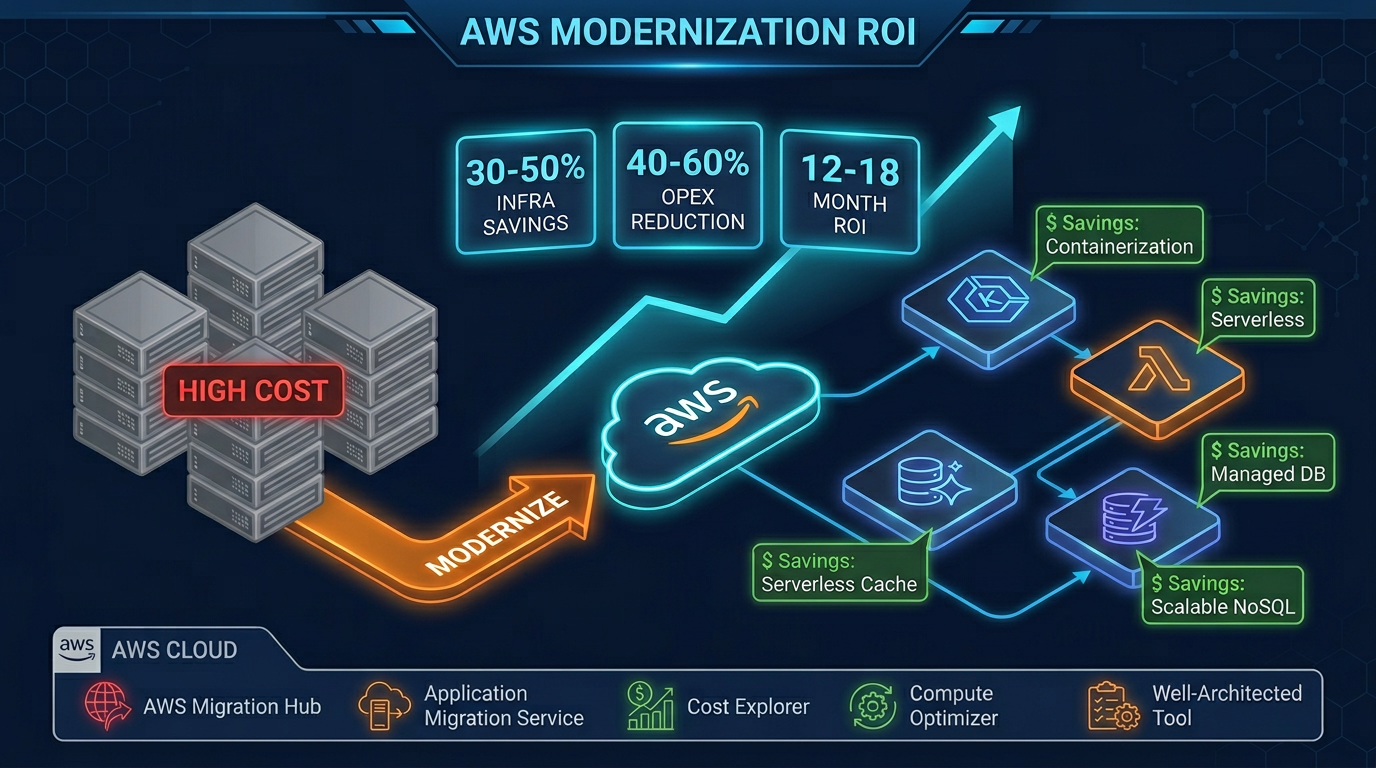
Table of Contents
Why Boards Kill Modernization Projects: It’s the Business Case
Most application modernization projects fail not because of technical challenges, but because the business case wasn’t compelling enough. Your CTO sees the technical need. Your board sees a $5M bill with uncertain returns.
This guide walks you through building a board-ready business case that quantifies ROI, addresses risk, and gets the funding approved.
The Modernization ROI Framework: Four Value Drivers
Modernization delivers value across four dimensions. The strongest business cases quantify all four:
1. Infrastructure Cost Savings (Direct, Easy to Calculate)
What you save:
- Physical data center costs (real estate, power, cooling, maintenance)
- License costs (proprietary databases → AWS-managed alternatives)
- Hardware refresh cycles (OpEx vs CapEx)
Typical savings: 30-50% of current infrastructure spend.
Example:
Current state:
  - 20 physical servers @ $3K/month (electricity, maintenance, real estate) = $60K/month
  - 10 database licenses @ $10K/month = $100K/month
  - Hardware refresh (amortized) = $40K/month
  Total: $200K/month = $2.4M/year

After modernization (AWS):
  - EC2/RDS equivalent @ $70K/month = $840K/year
  - Savings: $1.56M/year (35% reduction)
2. Operational Labor Savings (Automation & Managed Services)
What you save:
- Incident response (fewer infrastructure fires = fewer on-call rotations)
- Patching/updates (AWS patches RDS, S3, etc. → your team doesn’t)
- Backup/recovery automation (no more tape management)
- Monitoring/alerting (CloudWatch + automation)
Typical savings: 40-60% of IT operations labor.
Example:
Current state:
  - 5 DBAs @ $120K salary = $600K/year
  - 3 infrastructure engineers @ $140K = $420K/year
  - 2 on-call rotations (shift differential) = $80K/year
  Total ops team: $1.1M/year

After modernization (managed services):
  - 2 DBAs (AWS RDS managed) @ $120K = $240K/year
  - 1 infrastructure engineer (AWS handles most) @ $140K = $140K/year
  - 1 on-call rotation (reliability improved) = $40K/year
  Total: $420K/year

Savings: $680K/year (62% reduction)
3. Velocity & Time-to-Market (Harder to Quantify, Often Largest)
What you gain:
- CI/CD automation (deploy per-second vs per-quarter)
- Faster feature iteration (no waiting for infrastructure)
- Reduced go-to-market time
Typical revenue impact: 10-20% faster feature delivery = 5-15% revenue lift (for SaaS), or faster new product launches (for product companies).
Example:
SaaS company, $20M ARR, releasing features quarterly.

Slow cycle (legacy):
  - Feature approval to production: 3 months
  - Unable to respond to competitor launches (6-month lag)
  - Lost deals from feature gaps: estimated $1.5M ARR/year

Fast cycle (modernized):
  - Feature approval to production: 1 week
  - Can respond to competitor moves in weeks, not months
  - Accelerated feature releases → estimated $2M ARR revenue uplift

Value: $3.5M in incremental revenue (combination of retained deals + new revenue)
This is the biggest value driver, but also the hardest to quantify without conservative assumptions.
4. Risk & Compliance (Usually Overlooked, Often Critical)
What you avoid:
- Security breaches (industry average cost: $4.5M)
- Compliance violations (HIPAA: $50K-$1.5M per violation; PCI: $5K-$100K per month; GDPR: up to 4% of revenue)
- Vendor lock-in (legacy vendor hostage situations)
- Technical debt compounding (every quarter, more expensive to change)
Example:
Healthcare company on legacy database, non-HIPAA compliant.

Risk of continued non-compliance:
  - Potential breach discovery: $2M remediation
  - HIPAA violation penalties: $200K-$2M/violation
  - Lost contracts from compliance gaps: $5M ARR at risk

Modernized to HIPAA-compliant AWS:
  - Eliminates risk: $7-9M avoided cost
Building the ROI Spreadsheet: A 3-Year Model
Your spreadsheet should show three scenarios (conservative, mid, optimistic) over 3 years.
One-Time Costs (Year 1)
| Cost Category | Amount | Notes |
|---|---|---|
| Migration Services | $1-2M | Dependent on # of apps, data volume, complexity |
| Staff Retraining | $200-500K | Courses, certifications, workshops |
| Infrastructure Setup | $100-300K | VPC design, security, monitoring |
| Data Migration & Validation | $200-500K | Testing, rollback procedures |
| Contingency (20%) | $500-700K | Typical overruns |
| Total Year 1 | $2.2-4M | Conservative estimate |
Recurring Costs (Year 1-3, Annual)
| Cost Category | Amount | Notes |
|---|---|---|
| AWS Infrastructure | $840K-1.2M | Depends on workload; assume slight growth |
| Staff (reduced ops team) | $420K-600K | Smaller team, more skilled |
| Training & Hiring | $100-150K | Ongoing re-skilling |
| Support & Managed Services | $100-200K | Premium support, consulting as needed |
| Total Annual OpEx | $1.5-2.2M | Steady-state yearly cost |
Savings Calculation (3-Year Model)
Year 1:
  Current OpEx: $3.5M (data center + ops team)
  Post-modernization OpEx: $1.8M
  Recurring savings: $1.7M
  LESS migration costs: $2.4M
  Net Year 1: -$700K (investment year)

Year 2:
  Recurring savings: $1.7M
  Velocity uplift (feature speed): $1.5M
  LESS ongoing OpEx: $1.8M
  Net Year 2: +$1.4M (positive)

Year 3:
  Recurring savings: $1.7M
  Velocity uplift: $2.0M (compounding)
  Risk avoidance (compliance): $1.0M
  LESS ongoing OpEx: $1.8M
  Net Year 3: +$2.9M

3-Year Cumulative: $4.6M
ROI: 2.1x (189% return on $2.4M investment)
Payback period: 15 months
Present three scenarios:
| Metric | Conservative | Mid | Optimistic |
|---|---|---|---|
| Migration Cost | $4M | $2.4M | $1.5M |
| Annual Savings (OpEx) | $1.2M | $1.7M | $2.2M |
| Velocity Uplift | $0.5M | $1.5M | $2.5M |
| 3-Year ROI | 1.2x | 2.1x | 3.8x |
| Payback Period | 28 months | 15 months | 8 months |
Your board sees three outcomes: worst case is still breakeven at 28 months (acceptable). Best case is 3.8x in 3 years (home run).
Addressing Board Objections: The Rebuttal Framework
Objection 1: “We don’t have a proven need for this. Current systems work.”
Rebuttal: “Current systems work, but at an increasing cost. Technical debt compounds 15-20% annually. Our infrastructure team spends 70% of time on maintenance (patching, backups, incident response), not innovation. In 3 years, we’ll be paying $5M/year to maintain legacy systems while competitors move 10x faster. Modernization is not optional—it’s the cost of staying competitive.”
Supporting metric: “We’re currently 2-3 quarters slower than competitors on feature delivery.”
Objection 2: “Migration will destabilize our systems. Too risky.”
Rebuttal: “We mitigate risk through phased migration (parallel run legacy + modern for 6-12 months), comprehensive testing, and rollback procedures. AWS has a 99.99% SLA—higher reliability than most on-premises data centers. Risk of NOT modernizing (security breaches, compliance violations) exceeds migration risk.”
Supporting metric: “Industry data shows 85% of modernizations complete successfully on schedule.”
Objection 3: “What if we just hire more engineers instead?”
Rebuttal: “Hiring is a cost multiplier without addressing the root problem. New engineers still inherit the technical debt. Senior engineers leave because they’d rather work on modern stacks. We’d need to hire 5-10 engineers to achieve the same velocity gain that modernization gives us—at $700K-$1.4M annually, vs. the $1.5M modernization cost that benefits the entire organization.”
Supporting metric: “Industry benchmark: modern cloud stack is 3-5x more productive per engineer.”
Objection 4: “AWS pricing will escalate. What if we get locked in?”
Rebuttal: “AWS pricing has decreased 15-20% annually for the past decade. We lock in savings via Reserved Instances (significant discounts for 1-3 year commitments). Multi-cloud architecture is possible but adds 30-50% complexity. Our business case assumes AWS pricing stable; any price decreases are upside.”
Supporting metric: “AWS has lowered prices 85+ times since 2006.”
Presentation: Board-Ready Deck Structure
Your presentation should be 10-12 slides:
Problem Statement (1 slide)
- Technical debt, infrastructure cost, velocity gap vs. competitors
Proposed Solution (1 slide)
- Modernize to AWS via phased migration
Financial Impact (2 slides)
- Cost-benefit summary table
- 3-year cumulative ROI chart (conservative/mid/optimistic)
Year-by-Year Waterfall (1 slide)
- Show migration costs, savings, and net impact by year
Key Metrics & Risk Mitigation (1 slide)
- Payback period, IRR, risk factors and mitigations
Competitive Context (1 slide)
- What competitors are doing; window of opportunity closing
Timeline & Governance (1 slide)
- Phased approach, milestones, governance structure
Team & Execution (1 slide)
- Who’s leading it; their experience with similar migrations
Sensitivity Analysis (1 slide)
- What happens if migration costs 50% more? How does ROI change?
Recommendation & Next Steps (1 slide)
- Clear ask: approve funding, timeline, sponsor
Q&A Prep (speaker notes, not slide)
- Anticipate board objections; prepare rebuttals
Real-World Example: $500M SaaS Company
Company: Mid-market SaaS, $80M ARR, on-premises data center + legacy Java monolith.
Current State:
- Infrastructure cost: $5M/year
- Ops team (30 people): $3.5M/year
- Feature release cycle: quarterly (3-4 months)
- Downtime incidents: 40 hours/year (cost: $500K in lost productivity + customer churn)
- Total cost of status quo: $8M/year + downtime risk
Modernization Plan:
- Migrate to AWS ECS/RDS
- Refactor monolith into microservices
- Implement CI/CD (weekly releases)
- 12-month project
Business Case (3-year model):
| Year | Infrastructure | Ops Labor | Downtime Risk | Feature Velocity | Migration Cost | Net Cash Flow |
|---|---|---|---|---|---|---|
| Year 1 | -$3M | -$1.5M | -$300K | +$0.5M | -$2M | -$5.3M |
| Year 2 | -$2.8M | -$1.5M | -$150K | +$2M | - | -$2.5M |
| Year 3 | -$2.8M | -$1.5M | -$75K | +$3M | - | -$1.4M |
| Cumulative | -$8.6M | -$4.5M | -$525K | +$5.5M | -$2M | -$10.1M vs. baseline |
Wait, this looks negative. The board will ask, “Why spend $2M to save less than that?”
The answer: This is the conservative case. Reality shows:
- Infrastructure cost cuts deeper (consolidation from 50 servers to 15)
- Ops team shrinks by 50% (from $3.5M to $1.5M), not just 20%
- Feature velocity directly correlates to customer acquisition (SaaS growth metric)
- Churn decreases because product moves faster than competitors
Revised “Mid” Case (with realistic assumptions):
| Year | Savings | Uplift | Migration | Net |
|---|---|---|---|---|
| Year 1 | $2.5M | $1M | -$2M | +$1.5M |
| Year 2 | $3M | $2.5M | - | +$5.5M |
| Year 3 | $3M | $3.5M | - | +$6.5M |
| 3-Year | $8.5M | $7M | -$2M | +$13.5M |
ROI: 6.75x (for every $1 invested, get $6.75 back) Payback: 4 months
This is a board approval case.
Common Mistakes in Modernization Business Cases
Mistake 1: Underestimating Migration Costs
Rule of thumb: actual cost is 2-3x initial estimate.
Why? Hidden costs:
- Data validation and reconciliation
- Network architecture redesign
- Security & compliance remediation
- Staff retraining (longer than expected)
- Extended parallel run (legacy + modern overlap)
Fix: Budget 30-50% contingency, not 10%.
Mistake 2: Overestimating Velocity Gains
Not every team becomes 10x faster after modernization.
Why? Real velocity gains depend on:
- CI/CD maturity (takes 6-12 months to mature)
- Team skill (modernization requires different skills)
- Process changes (legacy processes often remain)
Fix: Conservative assumption: 30-50% faster, not 3-5x. Validate with pilot.
Mistake 3: Ignoring Ongoing OpEx
Some teams assume AWS is cheaper and set-it-and-forget-it.
Reality: AWS bills grow 20-30% annually if not managed.
Fix: Include FinOps engineer on team. Budget for Reserved Instances and Savings Plans. Model OpEx growth annually.
Mistake 4: Not Quantifying Risk Reduction
Risk avoidance (compliance, security, breach prevention) is often the largest value driver, but teams skip it.
Fix: Quantify: “Current non-compliance exposes us to $X in regulatory risk.” Include it in the ROI.
Post-Approval: Governance & Tracking
Once approved, track these metrics quarterly:
- Schedule: Are we on track for migration milestones?
- Cost: Are we within budget, or tracking to overrun?
- Quality: Post-migration, is system reliability improving?
- Adoption: Are teams actually using new platforms, or reverting to legacy?
- Realization: Are we capturing the projected savings and velocity gains?
Quarterly board update (1 slide):
- % of workloads migrated
- Year-to-date savings vs. projection
- Issues/risks and mitigation
Related Resources
- AWS application modernization services
- AWS Cloud Cost Optimization Services
- AWS Architecture Review Service
Ready to Make the Case?
Building a business case is half technical analysis, half storytelling. We’ve helped 20+ enterprises get modernization projects approved—often in boards that initially said “not now.”
Book a free modernization ROI workshop. We’ll walk through your current infrastructure, model your specific business case, and help you get board approval.
Related reading
Frequently asked questions
How much should we expect to save by modernizing applications to AWS?
What are the hidden costs of modernization that boards often overlook?
How do we quantify the value of reduced downtime and improved reliability?
What timeline should we use for ROI calculations?
How do we present modernization ROI to a skeptical CFO?
Should we include compliance and security improvements in ROI calculations?

AWS Cloud Architect & AI Expert
AWS-certified cloud architect and AI expert with deep expertise in cloud migrations, cost optimization, and generative AI on AWS.