AgentCore Runtime V2 GA: 1.9s P75 Cold Starts — Unit Rates Went Up
Quick summary: On Sep 18, 2026 AgentCore microVM Runtime V2 went GA — AWS P75 cold starts 1.9–2.0s vs 5.4–30s on V1, but consumption rates rose to $0.1276/vCPU-hour and $0.0169/GB-hour. Memory reclaim waits 120 seconds.
Key Takeaways
- On Sep 18, 2026 AgentCore microVM Runtime V2 went GA — AWS P75 cold starts 1
- 9–2
- 0s vs 5
- 4–30s on V1, but consumption rates rose to $0
- 1276/vCPU-hour and $0

Table of Contents
On September 18, 2026, AWS announced general availability of the next AgentCore Runtime on serverless microVM compute. You opt in per runtime with platformVersion: V2. V1 stays the default if you omit the field on create.
This is not Runtime Instances (EC2 capacity providers, 14-day sessions, GA August 6, 2026). V2 is a start-and-bill change on the microVM you already run: snapshot restores instead of full image start, and unused memory reclaimed after 120 seconds instead of held until the session ends.
Opinionated take: Flip V2 for cold-start consistency — AWS published P75 1.9–2.0 seconds on 200 MB–2 GB images versus 5.4–30 seconds on V1. Do not flip because the What’s New page said “lower costs.” Consumption list rates went up (CPU $0.0895 → $0.1276/vCPU-hour, memory $0.00945 → $0.0169/GB-hour). Reclaim only helps sessions that actually idle ≥ 120 seconds after a memory spike. Short support turns never hit that window.
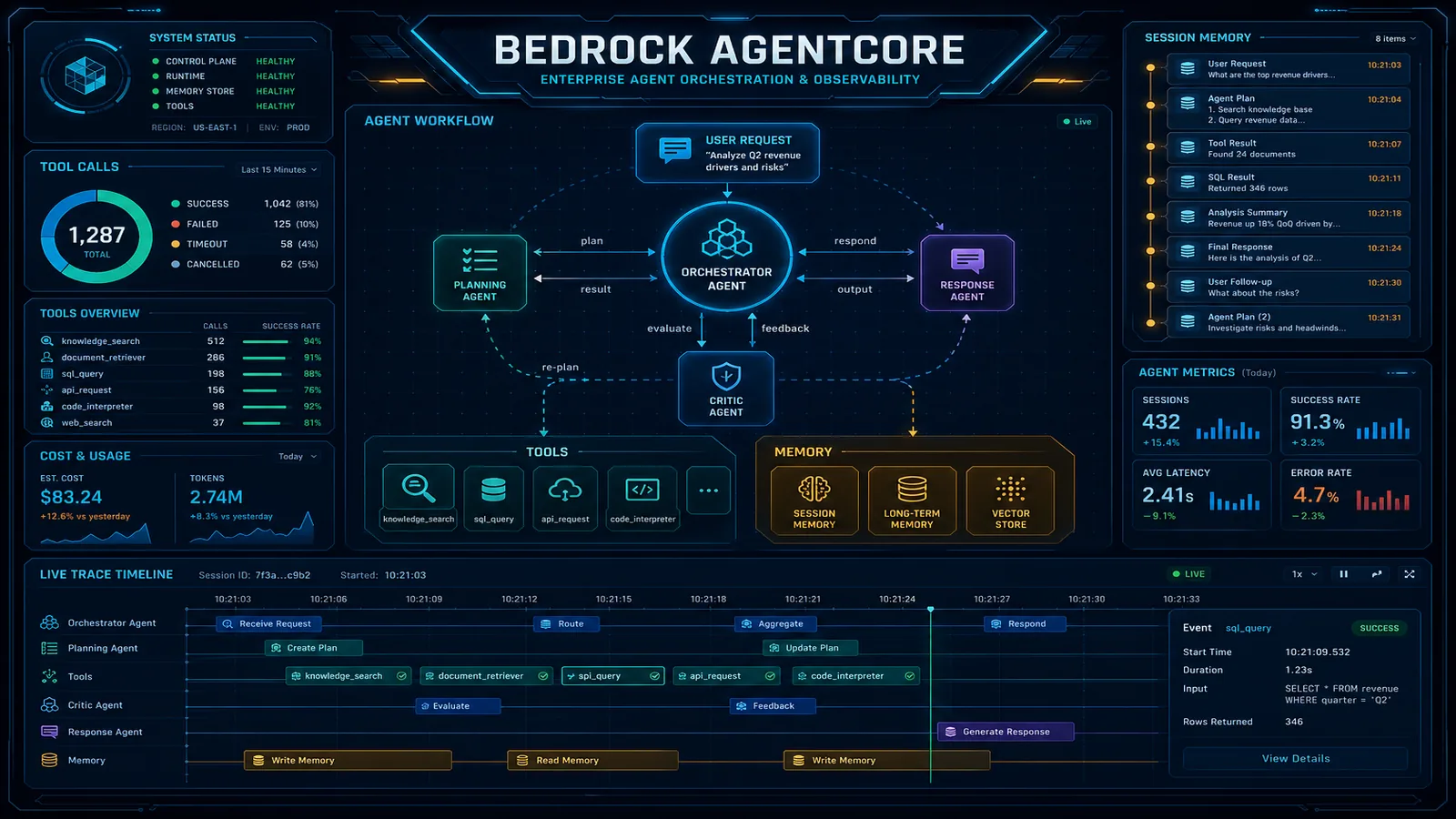
Platform map, Memory/Gateway/Identity, and Classic cutover stay in the AgentCore production guide. Component lines stay in the 12-components pricing post.
First-party signals we reuse here — Gateway canary on a B2B CRM assistant (12 tools, ~8k turns/day): median tool round-trip ~180 ms → ~95 ms after server-side Gateway (Gateway post). First-party TCO silhouette (July 2026): AgentCore support-style agent at 50K sessions/mo ~$791/mo platform + Haiku-like inference (decision guide). Those agents are microVM-shaped and short-session; V2 does not change Gateway or seat math, and a 3–5 second turn never reaches 120-second memory reclaim.
Reproduce this — Score
v1-vs-v2-decision-matrix.md. Fillv1-peak-vs-v2-elastic-cost-worksheet.csv(AWS published V2 example plus two labeled models). Runv2-canary-checklist.md. The AgentCore pricing calculator still uses V1 peak-memory rates dated 2026-07-04 — do not treat it as a V2 modeler.
What AWS shipped on September 18, 2026
| Dimension | microVM V1 (default) | microVM V2 (platformVersion) |
|---|---|---|
| Cold start | Full start per instance; AWS P75 5.4–30s from 200 MB–2 GB images | Restore a prepared snapshot; AWS P75 1.9–2.0s across that image range |
| Memory billing | Unused memory held until the session ends (peak-shaped) | Starts small; grows on demand; unused reclaimed after 120s; 128 MB floor |
| CPU billing | Active vCPU-hour; scales to zero on I/O wait | Same CPU-to-zero behavior; higher consumption rate |
| us-east-1 consumption | $0.0895/vCPU-hour, $0.00945/GB-hour | $0.1276/vCPU-hour, $0.0169/GB-hour |
| Create / update | READY in seconds | Snapshot prep: minutes; poll to READY / FAILED |
| Health check | Standard ping | First healthy /ping within 120s or create fails; that ping is the snapshot |
| Env vars | 4 KB | 1.5 KB direct code, 2.5 KB container (limit to be raised to match V1) |
| IaC | Existing CFN/CDK paths | CloudFormation and CDK cannot set platformVersion yet |
Regions (V2): us-east-1, us-east-2, us-west-2, eu-west-1, ap-northeast-1. Docs: platform versions. Pricing: AgentCore pricing. Snapshot code rules: optimize V2.
A committed baseline at $0.0997/vCPU-hour and $0.0132/GB-hour is listed as launching by October 2026. It is not applied in the worksheet.
The cost trap: higher unit rates, reclaim on a 120-second clock
AWS’s own V2 pricing example is a customer-support agent: 1 million sessions/month, 10 minutes wall-clock, 90% I/O wait, 1 vCPU while active, memory walking 1 GB → 2 GB → 2.5 GB. Published V2 compute: $0.006703/session, $6,703/month.
That is not automatically cheaper than V1. V2 CPU is 42% higher per active vCPU-hour; V2 memory is 79% higher per GB-hour. Break-even on memory requires billed average GB around 56% of the V1 peak (0.00945 / 0.0169). The 10-minute AWS example still bills enough GB-seconds that modeled V1 peak-held memory at old rates undercuts published V2 (~$5,429 vs $6,703). The What’s New claim of “lower costs” only holds when reclaim actually drops average GB far below peak.
| Silhouette | V1 Runtime compute | V2 Runtime compute | What it teaches |
|---|---|---|---|
| AWS published 1M × 10 min support example | Modeled ~$5,429/mo (peak 2.5 GB × 10 min at V1 rates) | $6,703/mo (AWS published) | 10-minute sessions: rate hike can beat reclaim |
| 50K × 5s chat turns (existing TCO shape) | Modeled $6.87/mo Runtime | Modeled $10.03/mo Runtime | Sub-120s turns: +46%, reclaim never fires |
| 120 × 8h sessions, 2.5 GB spike then 128 MB floor | Modeled $31.27/mo | Modeled $14.89/mo | Long idle-after-spike: V2 wins ~52% on Runtime |
The 50K / 8h rows are modeled list-rate math, not client bills. Open the CSV for the assumptions. Browser and Code Interpreter still list V1-shaped CPU/memory rates on the same pricing page — do not copy V2 Runtime rates onto those lines.
Choose V2 when:
- Image size or concurrency makes V1 start time a tail (AWS 5.4–30s vs V2 ~2s).
- Sessions idle ≥ 120 seconds after a memory spike (human wait, long tool/LLM I/O).
- You have scored the matrix ≥ 14 and will canary with Cost Explorer tags.
Stay on V1 when:
- Median turns are seconds (the 50K-session support shape).
- Starts are already fine and you have not modeled the rate hike.
- Primary Region is outside the five-Region V2 list.
Snapshot correctness — what breaks if you treat V2 like V1
V2 restores a snapshot taken after the first healthy /ping. Work at import / process start is copied onto every instance and frozen until the next create/update. Work in the /invocations handler runs per request.
What broke — Design-review failure, not a published client outage: a Gateway tool catalog (or STS session, or
uuid/randomseed, ortime.monotonic()start mark) loaded at module scope “because it is slow.” After V2 restore, every instance shares the same catalog version, the same request-id entropy, or a clock that does not advance across restore. AWS is explicit: hostname islocalhostand PID is1on every restored instance, so using either as a worker id collapses logs and locks. Detection: identical request IDs across sessions, expired credentials on a “fresh” instance, tool list stuck at snapshot time. Fix: refresh credentials and IDs in the handler; do not cache Gateway inventories at startup; BYO containers need snapshot-safe OpenSSL (openssl-snapsafe-libson Amazon Linux 2023). Direct-code deployments already ship a snapsafe base image.
Sockets opened at startup do not survive restore; client caches (endpoint resolution, pools) do. Expect the first call after restore to reconnect. Do not bind a fixed source port.
Enable V2 without pretending IaC supports it
Assumes AWS CLI v2 and bedrock-agentcore-control in a V2 Region. Replace the role ARN and ECR URI. Docs: Enable V2.
# AWS CLI — create a microVM runtime on platform version V2
aws bedrock-agentcore-control create-agent-runtime \
  --agent-runtime-name "my-agent" \
  --role-arn "arn:aws:iam::111122223333:role/AgentExecutionRole" \
  --agent-runtime-artifact '{"containerConfiguration":{"containerUri":"111122223333.dkr.ecr.us-east-1.amazonaws.com/my-agent:latest"}}' \
  --network-configuration '{"networkMode":"PUBLIC"}' \
  --platform-version V2
The create call returns while status is still CREATING. Poll get-agent-runtime until READY or *FAILED. A second update before that returns ConflictException. Confirm with --query platformVersion.
# boto3 bedrock-agentcore-control — create on V2, then poll.
# platformVersion is not in the create response; call get_agent_runtime.
import time
import boto3

client = boto3.client("bedrock-agentcore-control", region_name="us-east-1")

created = client.create_agent_runtime(
    agentRuntimeName="my-agent",
    roleArn="arn:aws:iam::111122223333:role/AgentExecutionRole",
    agentRuntimeArtifact={
        "containerConfiguration": {
            "containerUri": "111122223333.dkr.ecr.us-east-1.amazonaws.com/my-agent:latest"
        }
    },
    networkConfiguration={"networkMode": "PUBLIC"},
    platformVersion="V2",
)

runtime_id = created["agentRuntimeId"]
while True:
    got = client.get_agent_runtime(agentRuntimeId=runtime_id)
    status = got["status"]
    if status == "READY" or status.endswith("FAILED"):
        break
    time.sleep(5)

assert got.get("platformVersion") == "V2"
Omit platformVersion on create → V1. Omit it on update → keep the current platform version. CloudFormation and CDK cannot set the field yet — Console, CLI, or SDK only until AWS adds it.
Canary without rewriting InvokeAgentRuntime
- Baseline (Day 0) — session-duration histogram, vCPU-hour / GB-hour, P75 start, tool errors, $/successful session on V1.
- Score — decision matrix; proceed if sum ≥ 14 or a hard cold-start tail.
- Model — worksheet. If median session is under 120s and starts are already fine, stop.
- Canary (72 hours) — one non-prod runtime tagged
MigrationWave=agentcore-runtime-v2-canary; keep a V1 control; include a deploy that rebuilds the snapshot (checklist). - Promote or park — promote only runtimes that share the image-size / idle-after-spike shape. Keep V1 for bursty sub-120s chat.
What This Post Doesn’t Cover
- Runtime Instances (EC2 capacity providers, 14-day sessions) — Instances GA post.
- Full AgentCore platform map — production guide.
- Live V2 rates in the public calculator — still V1 peak-memory as of 2026-07-04 at the AgentCore pricing calculator.
- Committed-baseline GA — listed as launching by October 2026; not modeled as live.
- A re-run of AWS’s 1.9–2.0s P75 bench — we cite the What’s New numbers; measure yours on the canary.
- A first-party V2 production engagement — there are still zero published AI-agent case studies. Proof here is the artifacts plus AWS published figures.
What to Do This Week
- Inventory runtimes by median session length versus 120 seconds, container image size, and primary Region.
- Score each candidate on the decision matrix — canary only if sum ≥ 14 or cold starts already hurt.
- Model V1 peak-held versus V2 elastic on the worksheet before flipping production.
- Audit startup code against the optimize-V2 rules (handler-side IDs, clocks, credentials; snapsafe OpenSSL in BYO images).
- Canary one non-prod runtime for 72 hours with the checklist. Promote only if $/successful session or P75 start wins.
Need help choosing V1 vs V2 vs Runtime Instances for a production agent fleet? Contact FactualMinds — AWS Select Tier Partner with Bedrock AgentCore delivery across SaaS and regulated workloads — or start from generative AI on AWS.
Related reading
- AgentCore Runtime Instances GA: microVM vs EC2
- Amazon Bedrock AgentCore: Production Guide
- AgentCore Pricing: The 12 Components
- AgentCore Gateway Server-Side Tool Execution
- Bedrock AgentCore vs Amazon Q: Decision Framework
- AgentCore pricing calculator (V1 rates as of 2026-07-04)
- eCommerce AI Agents series — 64 parts applying these primitives to retail workloads
Frequently asked questions
What is AgentCore Runtime V2?
When should I NOT flip platformVersion to V2?
Are V2 unit rates lower than V1?
How fast are V2 cold starts versus V1?
What could go wrong after adopting V2?
Is Runtime V2 the same as Runtime Instances?
How do I enable V2 on an existing runtime?
Does V2 change session isolation or the 8-hour microVM limit?
Conceptual bounds
How the Runtime V2 stays bounded
Level 1 — conceptual. Risk medium. Oversight: monitored.
Account for Runtime V2 cold start and unit rates when you budget an agent.
- Starts when
- A team is planning Runtime V2.
- Tools
- This page does not grant tools. A later build still needs a named catalog, and anything unlisted stays unreachable.
- Stops for a person
- A faster start does not remove step limits or the write gate.
- Checked by
- Cost is modeled from the published rates and your session shape, not from a universal saving.
- Untrusted data
- Release notes treated as proof the agent is safe.
- If it fails
- Retry a timeout at most twice. Back off on rate limits. After repeated verification failure, escalate. Stop when the budget is exhausted or a permission is denied. No unbounded loop.
This page describes a bound. It is not a production agent and not a published deployment. The shared contract is the AWS store-agent architecture. Permissions and data boundaries are in securing store agents.

AWS Cloud Architect & AI Expert
AWS-certified cloud architect and AI expert with deep expertise in cloud migrations, cost optimization, and generative AI on AWS.